
Flyout Menu
Educational Model
Home » Metta Curriculum
Metta Curriculum

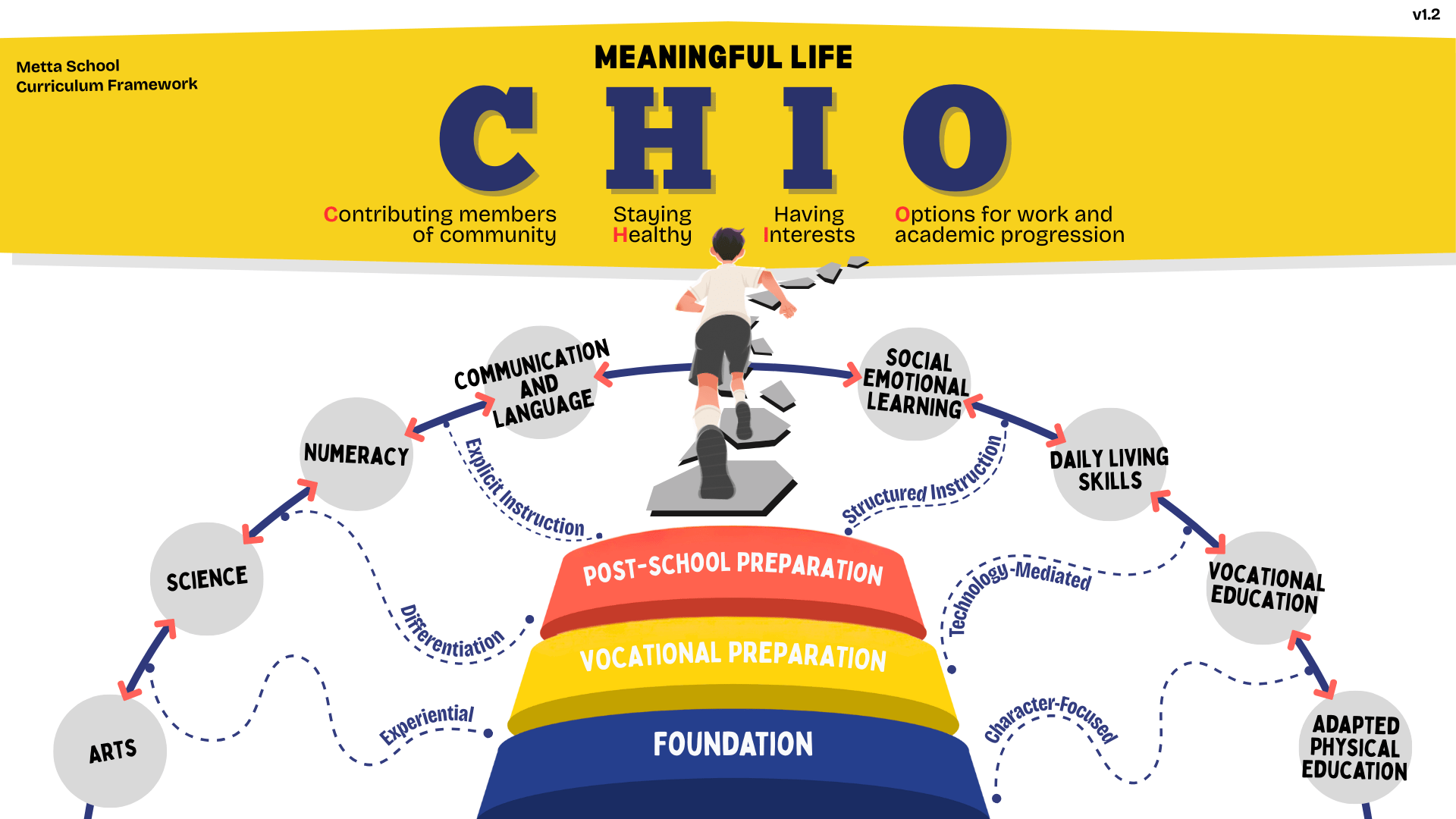
Central to the Metta Curriculum framework is a Three-Tiered Progressive Learning Pathway.
The curriculum framework centres on the school’s mission of enabling every learner to lead a Meaningful Life, represented by the acronym CHIO:
- C: Contributing members of the community
- H: Staying healthy throughout life
- I: Having interests
- O: Options for work and academic progression
At the heart of the framework is a vertical, pyramidal learning progression that represents growth from foundational competencies to independence. The pyramid symbolises coherence, upward mobility, and cumulative skill development. The three tiers include:
- Foundation (Level 1 to 6)
Students aged 7-12 acquire essential pre-requisite skills which form the base upon which higher-level competencies are built. - Vocational Preparation (Level 7 to 10)
Students aged 13 to 16 develop work-related and life skills which bridges classroom learning and real-world work contexts. - Post-School Preparation (Level 11 onwards)
The final tier focuses on transition-readiness, equipping students with knowledge, skills, and attitudes to move confidently into adulthood through various pathways.
The design of our learning pathways is anchored in 6 intentional approaches, which collectively shape how learning is enacted:
- Character-Focused
- Technology-Mediated
- Structured Instruction
- Explicit Instruction
- Experiential
- Differentiation: Structural & Instructional
The double-headed arrows depict the eight learning domains, underscoring the importance of developing each domain to achieve holistic student development:
- Social-Emotional Learning
- Daily Living Skills
- Vocational Education
- Adapted Physical Education
- Communication & Language
- Numeracy
- Science & Technology
- Arts
Together, this curriculum framework provides a coherent, inclusive, and future-focused pathway that empowers every learner to develop holistically and progress with confidence towards a meaningful and fulfilling adult life.
EDUCATIONAL MODEL
Main Menu